Hey fans!
With Fading West (the movie and album), Switchfoot has embarked on one of the most exciting times of their career. Excitement for the new music (and the movie!) is at an all time high, so we decided to sit down with the guys for a conversation/interview about the new project. Thanks to all the fans who submitted questions for this interview!
As previously addressed, Romey was in California for the birth of his son, Jackson.
Drew was busy with one of the following:
a) Trying to restart the government
b) Saving babies from railroad tracks
c) Recording guitar parts for Paul McCartney
d) Getting dinner, because we forgot to invite him to the interview.
Leave your guess and thoughts on the interview in the comments below!
]]>Over a year ago, we decided it was high time to finally sit down with the guys and have an exclusive interview… with questions straight from YOU guys! Hundreds of questions, a few random stories, some psycho-theraphy for Drew and one long interview later, we posted our first Exclusive LOBH Interview with Switchfoot. We had such a great time (Jon, commenting on it later: “So I hear it was the best interview EVER.”), that we’ve talked several times since about doing another session – but this one focusing specifically on your questions about Fading West. With the movie releasing in just a few short days on tour, and the album coming out in January, we’ve decided that now is the time for another LOBH Exclusive!
So here’s the breakdown - Submit questions for the band via Twitter, using the hashtag #SwitchfootLOBH or in the LOBH comments below. You can ask as many or as few questions as you like! Like last time, we’ll choose the most interesting and creative (note: again, creative, NOT weird. A certain amount of weirdness is good, but the goal is get more interesting, thought-provoking questions than you’d get in a typical interview) questions and ask the guys for you. PLEASE NOTE! We want to try to keep this interview “Fading West” themed – so ask about the album; the songs; the movie; the filming; process; the journey. Sorry, but questions about which Switchfoot guy is the best at karokee and who is the most annoying in the bus will have to wait for another time!
You have until September 30th.
Are you ready to go!?
]]>Matt Katsolis, of Interpret Studios, has spent over a year working on the film and he was gracious enough to talk with us about the film, the creative process and what he hopes the final product will accomplish. Read on for all the details and thanks to everyone who submitted questions for Matt!
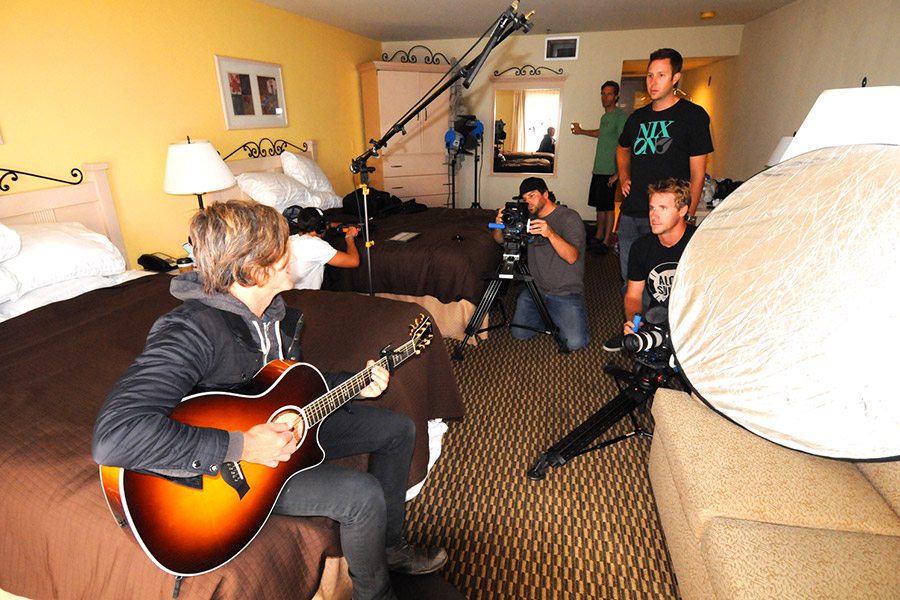
Filming Fading West
Land Of Broken Hearts (LOBH): Hi Matt, how are you?
Matt Katsolis: Doing great Jeanna – how about you?
LOBH: Keeping busy! Thanks for taking the time to do this interview with us today. I had fans submit questions for you about Fading West – they had quite a few! Feel free to be as thorough as you like in your answers.
Matt Katsolis: Gotcha- fire away!!
LOBH: First off… is the movie done?
Matt Katsolis: The movie is close to being done in terms of the actual edit, but there is still a lot of techinical work to be done, such as final scoring, sound mix, color grading and the final mastering.
LOBH: So how did you get involved in the Fading West movie? Were you a part of the conception of the movie or were you brought on board later?
Matt Katsolis: I was approached by my close friend Brian Nevins, a world class photographer, who does a lot of high profile photography in the film, music and action sports industry. He was working with a division of Switchfoot’s management, Red Light Management and Green Light Media and Marketing on a different project. When he heard that Switchfoot was looking to make a film that was comprised of music, international travel, surfing, and adventure, it seemed very fitting for my style of filmmaking and he recommended me to the bands management. That combined with the fact they wanted Brian to be the photographer for Bali and he said I was the only director he’d work with sealed the deal too.. ha ha.. Thanks Brian!
LOBH: HA! (It’s not WHAT you know…) How much say did you have in the planning process of the film? In other words, before filming started, how did you contribute to the “shaping” process?
Matt Katsolis: From the day we officially came on board to Fading West it was a very collaborative effort across the board – from the band’s initial vision, their managment’s concepts, and then interpreting that vision to how it would play out on screen. They had the basic journey in their minds, so we worked together over two and a half months of pre-production addressing the themes, locations, character arc’s and how those would play out at each location and throughout the film. A lot of things that may work on paper don’t translate that well into movies, so while some parts of the journey were clear, others had to be refined to make them speak the “language” of film. Film making is a very collaborative process with a lot of moving parts. Each decision results in a trickle down effect of building crews, schedules, budgets, flights, itineraries, shot lists, camera prep, film orders, and lots more behind the scenes stuff. Even a small decision in pre-production can change so much in the field. Once the band and our crew were on the same page of what the final goal of the film would be and the journey they wanted to take the audience on we were able to finalize the planning although a lot did change during production.
LOBH: Speaking of building crews, how large was your filming crew?
Matt Katsolis: Our film crew consisted of 5 people – in a perfect world it would have been larger to be able to share the work load of keeping up with the band’s very busy schedule, but it just wasn’t possible. To stay on budget, we had to have everyone on the crew wear mutliple hats. Our goal was to have 3 cameras operational everyday, with our specialty cameras for underwater, 16mm, and time-lapse always ready at a moments notice. Nic McLean, our Director of Photography, and our other cinematographer, Russell Brownley, were shooting 24/7. I ran camera almost everyday of principle shooting and even our AD/Editor/DIT Jesse Schluntz shot quite a bit as well. Even our AC/Sound Tech Sefton Tranter wound up shooting some memorable stuff. Daily we wanted 2 cameras up and running everyday, with a dedicated sound tech at the band’s side at all times, along with a speciatly camera and proudcer having the freedom to roam as needed to run timelapses, capture scenics, interview fans, and any other shots we wouldn’t be able to capture otherwise. Everyone our crew was an absolute workhorse, being the first one’s up in the morning to prep gear before the band was up, then starting our day with only a few breaks for food, then after a full day of shooting, staying up downloading footage, repacking our 16mm cameras, having production meetings and then getting to bed late only to wake up and do it all over again. Switchfoot has the energy level of groms, so they can be tough to keep up with at times. They would have a series of radio/tv interviews in the morning, then would head out for a surf until they literally had to leave for sound check, play a live set, maybe an aftershow, hang with fans and get to bed late. We would have to load camera’s, capture the experiences, change cameras for our surf cameras, put on wetsuits, pack waterhousings, get straight of the water, dry off cameras, download, change clothes and rush to sound check and the show. We hit a few kinks in the first international trip, but once we had a meeting figuring out how we could prioritize which content was the most important, things fell into rhythm
LOBH: How many months were you filming?
Matt Katsolis: It’s difficult to say exactly because we had 4 major international trips – Australia, New Zealand, South Africa, and Bali. However there was a lot of supplemenetal content that happened in between those trips that we needed to capture. From the first day we turned on a camera, to our final pick up shots, this past February was right at the year mark.
LOBH: What was it like shooting in so many locations worldwide and which was your favorite?
Matt Katsolis: That is a really tough question and I’m sure everyone in the band, and everyone on our crew, would give you a different answer. I had actually been to Australia, New Zealand and South Africa numerous times so it helped to know the location and conditions while planning the trips, but our crew overall is very traveled and most people on our team had been to all the countries on prior trips for other past film projects. Each country had moments that are unforgettable, but I feel like a parent having to pick their favorite child ha ha.. Having said that I would say that South Africa was my favorite trip just because it has always been such a magical place to me and when you combine that with getting to meet the Kuyasa kids in their township Kayamandi in Stellenbosch it was truly an amazing experience.
LOBH: I can’t wait to see the footage of that. A LOT of fans asked next question… Is the movie scripted in any way, or all just natural Switchfoot?
Matt Katsolis: The movie was scripted in the sense that the locations all served a purpose of their musical journey to create an album inspired by the sea, and the questions we asked the band in each location were very purposeful to address the themes of Fading West. We learned early on that Switchfoot is a grammy award winning band, not award winning actors! Ha ha.. We tried to do a few setup shots and scenarios but it didn’t feel natural. Once our crew had built the trust and repore of the band, the goal was to be vérité in our shooting style, being present but not noticed by the band… with the intent of capturing truthful and meaningul interaction between the guys both on and off stage. A lot of times we’d be a “fly on the wall” – to just get into a corner of a room and fall out of sight and mind with the band, and when they forgot our presence and that they were being documented, we were able to capture some very intimate moments of the band that have not been documented before.
LOBH: What kind of cameras did you shoot with and how many cameras did you use? I understand there was some filming done with an older camera?
Matt Katsolis: Fading West was shot on a range of cameras that spanned 50 years. Cinema is all about the visuals so we wanted to create certain “looks” for different scenes in the film. Aesthetically, we wanted to choose the right tool for the setting, so all in all, we shot on 8 or 9 different kinds of cameras. Going through airports was a bit of a nightmare when the attedant would see us walk in with 12 checked Pelican cases all at the 70lb mark and each crew member wearing a massive backpack crammed full of cameras and lenses. Some flights we would be asked to check our backpacks and have to try and hide lenses in our jackets and cameras in our laptop bags, it wasn’t a pretty site but we managed minimal camera casualties in the end.
In terms of specifics the high speed visuals in the film were shot on the Phantom camera, at 1,500 frames per second and showed Switchfoot performance unlike ever before. Day to day we shot a lot on the Canon 5D Mark III for its lowlight performance and versatility, the RED Epic for a lot of pickup shots, the Panasonic Varicam for Underwater footage, and two old film cameras, a Bolex H16 and a Kodak K100. The band had an idea to capture specific moments through their eyes and in a way that would look unique to their POV so we were able to come up with the solution of shooting on our old film cameras. Glad we didn’t sellt those because it adds some really special moments to the film and I think everyone in Switchfoot actually has 16mm shots in the film.
Oh yeah and GoPro’s! We rigged their boards up, on Chad’s drum kit, and about every place imaginable. One of the coolest shots in the movie is a barell Chad got in Bali holding the caemra behind himself in the barrel.
LOBH: I remember hearing that a gopro was hooked to some guitars too, right?
Matt Katsolis: Yeah we got wierd with those things. Put them anywhere and everywhere trying to capture new angles.
LOBH: You mentioned filming for about a year… How much footage was filmed, compared to what finally ends up on screen? What was your favorite moment that did not make the movie?
Matt Katsolis: In terms of how much footage was captured as to what will actually make the final film it would be safe to say that under 1% of the footage we have will make the final product. You know the saying you got a break a few eggs to make an omlette? Well, you have to fill up about 25TB’s of hard drives to make a film. It’s sad to think of how much hard work went into getting shots that will never see the light of day but there will be tons of amazing bonus features and we will try to find as many avenues as possible to show other really special moments that didn’t make the final cut.
LOBH: ….25TBS???
Matt Katsolis: If you step into the edit room you need to put on sunscreen, a bathing suit, and make sure to hydrate. It gets really really warm in their with the mountain of hard drives on.
LOBH: Haha! What were some of the craziest behind-the-scenes things that happened during filming?
Matt Katsolis: One that immediately comes to mind is at SoundWave when Sefton our AC/Sound Tech was helping me get a big jib shot of 30,000 people at the Marilyn Manson show after Switchfoot played. While we trying to carry a 10ft jib through thousands of people, I realized I forgot the lens I needed back in the bands greenroom, so as I turned to tell Sefton I was going back to get it, I got pushed into the crowd and my last glance of him, before he was absorbed into the crowd, was of a random woman who licked the side of his face and he screamed! At the time it was really freaky but in hindsight it’s hilarious.
Another moment that comes to mind was following the band down this super narrow goat trail that leads from the Uluwatu Surf Villas down to Temples – the main wave the band surfed while we were there. As some of our crew was navigating the trail, there is a section that you have to hold onto this tiny little rope and exposed tree roots. As Russ was climbing down the dirt gave way and half our crew was holding onto tree roots hoping they would support them and the 50lb camera bag and tripod on their backs. So amazing no one got seriously hurt!
Also almost everyone on our crew is an accomplished underwater cinematographer and they jump at the chance to shoot in water. That is until we got to South Africa… we were considering drawing straws to shoot water after hearing the water temperature. And then Drew mentioned that it was Shark week on Discovery Channel back home.
LOBH: HA! That’s equally hilarious and horrifying. On the polar end of that question… What were some of the greatest challenges shooting this film? For example, Chad sent me some of the footage from those intense moments where Jon had to get home because his daughter was in the hospital. I imagine it must have been difficult to film that… and to even decide to keep the cameras rolling in the first place.
Matt Katsolis: There are moments in film making where you have to cross a certain line and make a decision that will have a impact on the final result of the film. When Jon recieved the news that his daughter was facing an emergency, your natural reaction as a human and a friend, is to put down your camera and give them their space and walk away. However, as a professional, you know it’s those moments that define people and that crisis reveals character. Those moments could never be scripted and truly show the band at their most vulnerable and transparent. At that point in production, the crew had truly earned the trust and respect of the band, so as Jon went back to the hotel room to pack to go home to be with his family, the band left the door unlocked and let Nic enter quietly into the room and capture the raw honesty of the moment without them being aware of it. All in all, that decision to keep filming captured the heart of the film.
LOBH: With that in mind, how were particular parts of the movie and/or songs written during filming, inspired by the actual journey of filming?
Matt Katsolis: It’s a strange thing, knowing you are setting out on journey, knowing you are seeking to be inspired, but not knowing what those moments will look like, or how they will present themselves. Sometimes the band would get to sound check early and after they were prepped, they would start working on ideas that Jon had, and Tim would start laying down the base line as Chad found the groove. Once those elements were in place Drew and Romey would start creating all the layers and depth to the song and it just as you would start seeing it come together, it’d be time to clear the stage and open doors for the crowd. Other times it would be something as simple as a car ride and hitting the back of the seats to lay down the rhythm. When Jon was in his darkest hour leaving Australia to head home to be with his family, Tim felt inspired to pick up his guitar and start writing a song to deal with what was happening. Again, a moment that never could have been planned or forseen yet it led to a new song for the film and potentially the album. Their jam session with Rob Machado at the edge of the cliffside in Bali is also unforgettable.
LOBH: You mentioned earlier planning character arcs and choosing a final goal – can you share a little bit about what that will look like in the finished product?
Matt Katsolis: In terms of developing character arcs and the film itself, its a really tough challenge to only have just over an hour to convey the band, the heart behind their music, their journey, and the themes. You don’t know if it may be the only 80 minutes you get in someone’s life to show them who Switchfoot is and what drives their passion. In the end, the decision was made to create an art house film which has certain benefits and free’s you from the constraints of traditional cinema. Working with the band, we went back and forth on which parts of the story were crucial and which ones could become special features and supplemental pieces. We didn’t always agree in the edit room, and had clashing opinions, which can be tough at times, but also it can be a good thing. We ultimately met in the middle, in that they implemented a lot of our notes while at the same time, told the story they wanted to tell. I know earlier in the interview, how I talked about our film crew wore multiple hat… well Switchfoot wears just as many, if not more. In addition to having the pressure to create a new album, they are also balancing being professional musicians, touring, filming for Fading West, press apprearances, recording, and being husbands and fathers. They are one of the hardest working bands I’ve ever encountered, and the reason they continue to work so hard to make such powerful music is because they believe every word of what they sing.
LOBH: What reactions are you hoping to get from the viewers/fans after watching this movie?
Matt Katsolis: My hope is that the audience who already knows Switchfoot sees a new level of depth to the band that they have never had access to before. That they see how the guys are truly so grateful to be where they are at today, yet still so motivated to continue pressing forward, writing news songs and taking them around the world. Additionally, I hope a new generation of people will be introduced to their music and will see how different it is from other mainstream music. That they will question how the other music they listen to stands against a band that will only write and sing songs they believe in. The creative process that leads to these timeless songs that have impacted and changed so many lives is so unique ,and I feel will affect a lot of viewers as they get to know Switchfoot. They may just see that there is a greater purpose and force behind it much bigger than the music itself – that has kept kids from committing suicide and made people question what they were really living for.
LOBH: Matt, thank you so much for your time and handwork. We cannot wait for this movie… I think it is going to be truly remarkable!
]]>
Land Of Broken Hearts (LOBH): Thanks for taking the time to talk with us. We asked our site visitors to submit their questions for you then chose our favorites for this interview. First – and I think this is a question that almost everyone wants to know - How’d you come up with the idea for the video? What inspired the concept?
Bryant Janson: Well, first and foremost it was inspired by the song. I knew I wanted to do something fun, quirky, and somewhat (no pun intended) original. I was also pretty inspired by the parts of LA that are filled with nature and beauty, but overshadowed by the gigantic city. I feel like not many people know these places exist. I had a very specific location in mind for the video originally, and there are many homeless people who live in that area. I wrote the story around someone who would call a place like that home, and how they would deal with someone who lives in the more urban area next to them (We ended up not being able to shoot at the original location because of the weather, so we scrambled and found a great area in Elysian Park that had a similar feel). I wanted the two main characters to be as different as possible. The story was basically just a classic schoolyard challenge between these characters, but I tried to give their interactions a weird and comedic immaturity.
LOBH: Is this video what came to your mind after listening to the song?
Bryant Janson: Not originally, but after listening to it a few times I thought that type of vibe would fit the video pretty well. Hopefully people think it fits the song.
LOBH: Is the protagonist homeless or living off the grid?
Bryant Janson: I think that really depends on how you define homeless. He clearly has a home, but it’s just not what most would consider to be ideal in a place like LA. I think the character would say he is living off the grid, but I feel like most people would call him homeless if they saw him.
LOBH: What do the mirrors mean?
Bryant Janson: In the end, that’s up to the viewer to decide. I wanted to show the strong man as a fairly vain person, and watching yourself do bicep curls through a hand mirror is pretty vain. It’s also a good way to annoy your neighbor.
LOBH: What thought process went into the casting for this video?
Bryant Janson: I wanted to find interesting people who fit the roles visually. I was incredibly lucky to find the actors that I did. I want give a huge thank you to Neal Polister, Robert Rexx, and Belinda Bates for doing such a great job.
LOBH: Why did you chose to shoot all in slow-motion considering thehigh-octane feel of the song?
Bryant Janson: I think slow motion makes the mundane feel epic and exaggerated, and I wanted to really exaggerate this story. Plus I think funny things are even more funny slowed down. I wanted the fast pace to come from editing and jump cuts. Also, I wanted the few shots that weren’t in slow motion to have more of an impact.
LOBH: In talking with Chad, he talked about how they had asked several directors to do treatments for the video, so I’m assuming that’s why the guys didn’t appear in the video – but a lot of people asked the following: “Is there a reason why the Switchfoot guys aren’t in the video?” Can you elaborate a little bit more on that?
Bryant Janson: I was asked to write a treatment for the video that didn’t include the band, so I think that was the band’s choice.
LOBH: Is there a specific message you wanted to get across, and if so what was it?
Bryant Janson: Don’t be a jerk, or someone will beat you in a bike race.
LOBH: What was your favorite scene to shoot?
Bryant Janson: I had a lot of fun on the whole shoot, but I would have to say that Robert throwing the cement pieces, logs, and shopping cart was probably my favorite setup of the day. It was super funny.
LOBH: What is something you personally were able to learn/take away from this particular directing experience?
Bryant Janson: I am a Director of Photography typically, so this really was the first time I directed anything (I have co-directed one or two music videos, but never by myself). I learned a lot. I work with cameras for a living so I am pretty comfortable with that side of the process. The biggest learning experience for me was in communicating with the actors and dealing more with that side of things. I was really lucky to have such a great crew that made everything work so well during our crazy day of shooting.
LOBH: How long have you been filming videos?
Bryant Janson: I have been doing film stuff since I was in Highschool. We would make short films, film skateboarding, etc. I guess I just kept doing it and realized I could do it professionally. I went to Film School in Montana and discovered that I love cameras and lighting. After school I moved down to LA to try and become a Director of Photography. I have been shooting music videos fairly often for the past couple years, along with commercials and the occasional movie.
LOBH: What got you interested in this particular field?
Bryant Janson: I just love cameras, lighting and storytelling. I very first became interested because I wanted to learn how to make skateboard videos with my friends. I quickly realized I wanted to make movies.
LOBH: What are your future projects?
Bryant Janson: I have some exciting music videos coming up with some great directors, a feature film fairly soon, and some commercials in there too. I’ve also been shooting a documentary that is in post production right now. With the way this industry works, it pretty difficult to even look very far in the future though. My website: www.bryantjansen.com, and my google+ page are places to check out some of my stuff (though I’m in the process of updating and redesigning those).
LOBH: As a bonus, we have 3 questions we ask to everyone we interview: 1. What’s the best advice you’ve even been given?
Bryant Janson: Know something about everything, and everything about something.
LOBH: 2. What’s one song you wish you had written and why?
Bryant Janson: “White Christmas” by Bing Crosby – because it’s supposedly the highest grossing single of all time. (I know thats a cop-out, but I like too many songs to answer fairly)
LOBH: 3. What’s one question you’ve never been asked and the answer?
Bryant Janson: This one.
LOBH: Thanks for your time Bryant and good luck on all your future endeavors!
To read more LOBH Exclusive Interviews, click right HERE!
]]>Ever since we first heard the song “For the Sender” on Fiction Family’s first tour, the song has found a home in the hearts of music lovers all over… so when we heard that there was a project surrounding the tune, we got excited. We here at LOBH are STOKED for the upcoming “For the Sender” project featuring Jon and Sean Watkins and many other San Diego artists. In just a few weeks, the “cast” of artists will be on stage, “when the voices of Switchfoot, New Found Glory, Nickel Creek, Jack Tempchin, Molly Jenson, Nena Anderson, and Alex Woodard will present the letters and perform the songs of ‘For the Sender.’” The CD release, featuring two songs by Jon, “Never Alone” and “Unbroken”, is just around the corner as well. (If you’ve missed our updates on this release, you can get the low down, as well as listen to song clips and read lyrics HERE!) Musician Alex Woodard, the man behind the project, explained it a bit more fully on the For the Sender website:
Sometimes a letter is like a prayer, written more for the sender than the receiver. There are unsent letters tucked away in dresser drawers and buried in boxes everywhere, serving as testimony that sometimes it’s enough to just write it down. You might have a letter of your own somewhere that nobody has ever seen.
But what if you opened the drawer? What if you did send that letter about your fears and insecurities, your hopes and triumphs?
Our family of songwriters and musicians in north San Diego county wrote songs about some of those letters, and we’ll be releasing ‘For The Sender’ in early 2012. We asked the senders of the letters to choose a favorite charity, and a portion of the proceeds from sales and tours will benefit those causes. Join us as we make the journey of delivering the songs to the people who inspired them: you.
We took four letters and wrote songs about them, which evolved into a book, album, and concert event called ‘For The Sender.’
I know how excited you all are for this release as well, so we decided to chat with Alex to find out more stories and info on “For The Sender”. Read on!
Land of Broken Hearts (LOBH): The name for the project is based off of the Sean Watkin’s song “For the Sender” correct? What made you choose that name?
Alex Woodard: Sean and I wrote that song together about the letter than inspired the project. It was from a woman named Emily. She lost her soulmate one autumn and every year since then she writes him a letter to tell him about her year and what she’s been doing. That letter she writes is more for her than for him; it’s her way of dealing with things. One of the lyrics in the song is ‘Every year I write you this letter/But like a prayer, it’s more for the sender.’ I think we often write for ourselves, not for the reader or listener. When I sit down to write a song, it’s usually because I have something I need to get out. When someone writes a letter, even though it’s addressed to someone, it’s often because they want to express something.
The interesting thing is that all these songs, the surprise private performances, even part of the proceeds of the project, are all for the senders of the letters. They may have written their letter for themselves, but we’re doing something for them. So ‘For The Sender’ kind of nailed it as a title.
LOBH: Tell us about the moment when the idea for this project formed and became reality.
Alex: There are so many layers to this project, from the book to the album to the performances, and each layer has its own genesis. It’s like what looks like a forest now is made up of trees that grew from their own seed. But I remember the moment I first thought about writing a song for someone who sent me a letter. I was in L.A. and somebody asked me how I could personalize what I was putting out into the world… how could I make people feel like what I was doing was just for them. And my first thought was ‘write a song about their story’.
LOBH: What has been your favorite part of the project so far?
Alex: The co-writing with and producing artists I respect has been really special, but I think my favorite part has been playing the songs for the senders… traveling from Connecticut to Oceanside to Haiti to surprise these women with songs written just for them.
LOBH: Have there been any unexpected surprises or difficulties with For The Sender?
Alex: The process itself was a challenge, because I had to be patient with everyone’s schedules and other commitments. Not only that, but I didn’t really have a vision for the project until I was already knee-deep in it, and I had never written a book before, so I had to really trust the process. The biggest surprise was when I realized that I had my own letter, written but never sent, tucked away in a box high on a shelf in my living room. And I had a song that I didn’t realize I had written about that letter. I wrote the letter to my dog the day she died, and it was tucked away with her ashes. The song is called ‘The Table’, and a live version of it is the last track on the album.
LOBH: How has the response been so far, from the letter writers to the artists involved?
Alex: There’s a moment in the video with Jon after we left the shelter when he sees the book for the first time, takes it in his hands and shares his thoughts. The response to the project has ranged from that to tears and laughters and a sense of relief and resolution. I think each artist and letter writer respond to it according to where they are in their lives. It’s almost like the project is a mirror to them.
LOBH: Speaking of, how did Jon Foreman become involved?
Alex: We often surf together and would have an ongoing conversation about the project in between waves. One day out in the water I asked him if he wanted to get involved, and he said yes. Even though we did ‘Unbroken’ and ‘Never Alone’ together, I don’t think he really knew it was really happening until he actually saw the book for the first time. You can watch it on the sender site in the shelter section. http://www.forthesender.com/theShelter.html.
LOBH: What’s your personal favorite song from the different artists that contributed?
Alex: That’s a tough one. I produced and wrote or co-wrote all but one song, so I’m pretty close to them all. ‘My Love Will Find You’ seems like a special one to me though. But now that I say that I’m thinking ‘Never Alone.’ I can’t really pick just one. Sorry, that sounds like a cop-out, but it’s true.
LOBH: Do you have a goal or specific purpose that you are hoping to accomplish with For The Sender?
Alex: Part of the beauty of this project is that I’m just letting it be what it wants to be. It’s as if it’s telling me what way to take it, so I’m staying away from specific goals. But if I can move you and help you feel not as alone on your journey, I’ll be happy.
LOBH: Will the concerts extend past just one night? A few people asked about a tour across the states…
Alex: Absolutely. It will likely be a revolving cast depending on tour schedules, but we’ll be out there.
LOBH: When and where will we be able to buy this project? Will it be released on vinyl?
Alex: We’ll release it in early spring 2012. We’re still working out the distribution details, but it will be available online as an ebook and audiobook with the songs embedded, and in print editions at stores and online. It likely won’t be released on vinyl because you’d need a pretty big book to fit a record on the inside cover. You never know, though.
LOBH: What can fans expect at the ‘For the Sender’ concert event?
Alex: We’re going to present each letter and play the corresponding songs in a creative way that tells a story, with some surprises here and there. We’ll be filming it for a DVD, so I’ll leave some suspense and not give too much away…
LOBH: Alex, thank you so much for your time! We can’t wait to see the journey that this project will take.
Share your thoughts/reactions/excitement in the comments below!
Stay updated with the progress of this project by visiting the For The Sender website, following them on Twitter, and of course, checking LOBH!
]]>Land Of Broken Hearts (LOBH): Tyler, thank you so much for talking with us today. Our first question, I’m sure, is a given. When can we expect the new Fiction Family record to be released?
Tyler Chester: We nearly hustled and released it this last Spring- we were talking May possibly, but then we felt like it wouldn’t really get the attention it deserved, since the new SF comes out late Summer. So, at this point, some time next spring. Which is good news for the music itself, since we’ll have some more time to tweak with it.
LOBH: So is the album “done”? Or are you using this extra time to sort of refine the songs?
Tyler: I’d say the album is… 88 % done. We might overdub a few things here or there. It isn’t yet mixed. But probably all of the songs that are there, will be there when it’s finished.
LOBH: Do you have a title for the new album yet, or artwork?
Tyler: No artwork- a few titles, but they’re sort of tounge in cheek. Fiction Family- 20 Greatest Hits. Haha! Maybe.
LOBH: That’s brilliant.
Tyler: And there’s only maybe 13 songs!
LOBH: I love it. I vote for that title. But I assume the “official decision” won’t be made till much later?
Tyler: Yeah, we’ll probably decide on something down the road a bit.
LOBH: Have you discussed possible singles yet, or is that also further down the road?
Tyler: Hmm – I suppose if we had one, it’d be ‘Give Me Back My Girl’. That songs translates immediately. And it’s quite catchy.
LOBH: I love that song! Out of all the songs you guys have played live recently, that one has gotten some of the best responses.
Tyler: Yeah, that’s a good one. One of my favorites.
LOBH: Just Rob Me has also become a fan favorite, and many fans are wanting some official confirmation that the song will be on the next release. Will it? Are you able to share the tracklisting at this point?
Tyler: Yeah, Just Rob Me is on there for sure. A very good version of it – with a great Sean Watkins guitar solo. I can give you a rough list of songs. Besides those two (Just Rob Me & Give Me Back My Girl) there is Damaged, Fool’s Gold, Guilt, Notch on the Tally, Up Against The Wall, Monster, My Forgetful Baby…. and my personal favorite, God Badge. There are a few other’s as well, but I don’t know if they are named or not. God Badge is maybe my favorite Jon Foreman song ever – up there with Vice Verses.
LOBH: I was planning on asking you what your favorite song was from the new album, but you already answered that! So maybe you could elaborate on WHY it’s your favorite? That’s certainly high praise for the song. Vice Verses is shattering. Amazing.
Tyler: Yeah, Vice Verses is amazing, and I’d put God Badge on the same level. God Badge says a lot of things about love and fairness and forgiveness that are hard to put into words. One of the great things with these FF songs is that I feel like I can stand behind each and every one, both musically and lyrically.
LOBH: I like that – it always feels different when the artists believe in the songs. So what’s the overall theme of this record? Is there one yet?
Tyler: I’d say the over-all theme is really the chemistry between the four of us. Most of these songs were recorded essentially live (with a few overdubs), often the four of us sitting in a circle, without headphones. It was very much like the first few times we played together – in Sean’s living room, singing and playing and listening. There’s definitely a certain groove and chemistry that has grown between us four.
LOBH: So how has the sound evolved now that the band has more members? You and Aaron are “officially” part of the band now right?
Tyler: Yeah, Aaron and I are part of it now, and having Aaron has been huge. The first Fiction Family record was built on acoustic guitars, mostly. But this one is almost without exception built on drums. Not in a jazzy way or anything – more like Levon Helm or Jim Keltner drums – deep, lazy grooves. Sean plays some electric guitar, which is pretty amazing for a bluegrass kid, and there are a lot more keyboards throughout. And there’s simply nothing like tracking together at the same time. Most records these days aren’t made that way, but that’s the old way it was done, and since that’s where the inspiration for the songs largely came from (the ‘old days’ of Dylan, The Band, John Lennon, etc), us tracking together as much as possible was important.
LOBH: That reminds me of your guys’ live cover of Idioteque – where the three of you gather around a mic and sing.
Tyler: Yeah, those types of moments have always been the best. There’s a part on Up Against The Wall where it was the 3 of us overdubbing these huge background vocals on one mic.
LOBH: So what’s the process like while working in a band where all 4 of you have such busy schedules and other musical endeavors?
Tyler: It’s tricky – this album was recorded over nearly 2 whole years, usually 2 or 3 days at a time. But we were all able to put our full attention into it for those 2-3 days, so I don’t think the music suffered – it just took a long time!
LOBH: I always felt fiction family’s music aged like wine anyway. We asked for questions from fans, and a few bass fans have wanted to know how much bass will we hear from you on the new record?
Tyler: Ha – well, there’s plenty of bass, although no bass solos or anything silly like that. And I played lot’s of keyboards as well- piano, rhodes, pump organ, moog…
LOBH: Another fan, Chris, asks, “Any unique things you did in the recording?? Alternate tunigs? Effects? Counter-rhythm lines? Counter-melody sounds?”
Tyler: Hmm – we recorded on open Rhodes top, which is pretty unique, on God Badge. And there are some very cool string parts on Fool’s Gold (Sara Watkins played those), and an electric guitar solo (Sean – a very unique sounding electric guitar solo). Our focus was definitely on songs, and making the songs come across as good as they possibly could. So, there aren’t any weird time things, but there are some very sick grooves.
LOBH: How is this record different from the first Fiction Family album?
Tyler: Well, the songs on the first one were good, but the songs on this one are REALLY good. Because they were built amongst us 4 (as opposed to the 1st album which was more Sean would work on this song for a bit, and Jon would work on it for a bit), they were very often completely deconstructed and then built back up and then, while still exciting and visceral, recorded. And like I said – awesome songs.
LOBH: What’s the most exciting thing we can expect from this new album?
Tyler: These songs really stick with you, the way classic old records do. Like old friends you haven’t seen in a while. That’s the best part.
LOBH: You’ve had a tour with Fiction Family and a number of live shows. What’s your favorite moment at concerts?
Tyler: There’s a great camaraderie playing with these guys. No one ever phones it in – every night is important and exciting and totally new. And that, believe it or not, is a rare thing in the music industry. So my favorite moment… is the part between when we start and when we finish. haha!
LOBH: Hey that’s our favorite part too – well.. not the finishing part. We’d rather it go on longer.
Tyler: Ha – me too
LOBH: To wrap up, you’re in a band with 3 other members from very different musical backgrounds and all with diverse personalities. What’s one (or two if you must) word(s) you would use to describe each member of the band?
Tyler: Aaron – The backbone
Sean – Virtuoso Guitar Player (sorry that’s 3)
Jon – Fearless/Energetic
LOBH: Tyler, thank you so much for your time! We’re super stoked about the new record, but details have been scarce so we really appreciate you chatting with us!
Tyler: Sure thing – excited for you to hear it! And I’ll see you back out there on the road somewhere.
Discussion Point: It’s Monday, so of course it’s time for our Monday Comes Around Song Discussion! In the spirit of the update, let’s take a look at a Fiction Family song today… so let’s discuss Betrayal (Fiction Family)! This was the song that started it all for Fiction Family, and it’s been near and dear to our hearts for some time. Head to the comments below to discuss the story of the song, the lyrics, your favorite lines (Mine? “someone always wins and then they write a book”), and your earliest memories of this tune! We’ll see you there!
Jeanna: “Ryan thanks so much for talking to us today, we really appreciate it. I guess we’ll start at the beginning… how long have you worked for Switchfoot and how did you get started with them?”
Ryan: “I’ve been working for them for 9 years. It started when I was working for another management company and Switchfoot had a different guy with them at the time, but he was unable to be there for a few shows, so I said “Sure, yeah, I’ll fill in” and I just had a great time…. loved it. So I told them, “Hey if you ever need help again, just let me know” and sure enough, a couple of months later the guy they had at the time left, and they called me and it worked out, so I started working with them. I was with another band at the time, pretty good gig… I got huge breaks from that, so I told them at first, I was just going to do a when I could fill in kind of thing, nothing full time, but that quickly changed! When you meet the guys you understand why! They’re just SO great to work with, from everything to their songwriting to… well as you can imagine, when you tour with someone it’s not just a “job” – it’s pretty much an entire lifestyle. It’s like a family, so it’s pretty important to like the people you work with and get along. There’s a lot of people out there that don’t necessarily care… they just get gigs here and there and they could really care less, but I’ve always looked for more than that. The guys obviously provide a great environment and it’s just an amazing thing to be a part of, I mean I’ve felt blessed to even just be able to spend time with them and work with them, and here it’s been nine years! It’s hard to believe. It has been great. Long story short, that’s pretty much it. I just kind of fell into it and next thing you know… 9 years. And there’s no looking back, so it’s been awesome.”
Job: “Could you outline your duties? Like what does a day look like for you?”
Ryan: “I’m not just their sound engineer, I’m also their production manager so basically any time there’s a show – any sort of event – I even do Jon Foreman’s solo stuff as well as Fiction Family stuff, so if there’s any performance by the band, whether it’s on a TV show, whether it’s in a hotel ballroom for an acoustic thing… anything like that. I have to advance all the requirements and what the show will entail as far as sound, lights, whether we need backline and if you don’t need backline, how are we getting our backline there – the logistics of all of that. That can be as simple as going to the studio and picking up our gear in an abandoned trailer and driving it 20 minutes down the road to a show or it can be as complicated as flying to Australia with our gear and then playing on rented backline every single day. It’s totally different.
Long story short, a normal tour day is typically waking up at – sometime in the morning! Then spend a little bit of morning time working out, having breakfast, relaxing – pretty much my window of free time is in the morning. Probably at about 9:00 or 10:00 I’m loading the show – but now that’s if we’re handling all the production; if that’s being brought in… because a lot of times I’ll just have a local company do that. So they know what I want basically, so they handle setting it all up. Luckily on those days, I don’t have to get in till maybe 1:00 or 2:00 in the afternoon, at which time we bring in the bands gear, set up the stage. I oversee all my crew guys as well as the local crew guys, making that happen. Then the lighting – as soon as I can, I have to get our lighting guy on the system because a lot of times it’s different equipment to deal with. The band comes in, typically at around 4:00 for a soundcheck which can last anywhere from half an hour to an hour and a half, depending of if they have new songs they’re working on, or if they have something they want to rehearse, because that’s their only window to do that. So we finish that, let the other bands get on stage – (of course this is all if we’re headlining). Then at that time, we go eat dinner, relax a little bit, make sure things are cool for the doors to open up – typical time would be 7:00.
The show would then start at 8:00 and we go on anywhere between 9:00 to 10:30 and then play usually about an hour or an hour and a half… now that is when I run sound for the band, out front, next to the guy running lights. We run the show, show ends, we break everything down, put it all away and go on to the next place! That’s my day!
Jeanna: “That’s an INSANE day.”
Ryan: “Yeah then you wake up and do it all again!”
Jeanna: “Along those lines, we solicited questions from the fans, and one fan asked ‘With back to back tours and busy schedules, how do you prep for each show in order to not burn out?”
Ryan: “That’s a good questions. I mean obviously there is only so much you can do ahead of time but of course doing as much as possible ahead of time saves a LOT. It basically means I, in advance, prep everything with the local crew, of course our gear is all set up, so that whatever of our own stuff (or if we’re going to go on tour and rent things long term) it all gets labeled. So basically you go in with the mindset that I’m going to break this down as little as possible so that tomorrow I have to set it up as little as possible. So the little things – like Chad’s drum kit, you know you only take apart as much as you need to, to get it to fit in the box type of thing! Now we’re getting ready to go to Australia and South East Asia and every day we’ll have a different drum kit, that won’t be set up for Chad. So the set up takes a lot longer… that’s pretty much where I would say, I prepare for that by working with people that I like! It makes every other aspect of touring enjoyable because it can get really… you can get burned out I guess. But I am just lucky enough, because I really love it, I love the people I work with, we have a great time, so I enjoy it. Now I’m away from my family, so it’s a hassle, but I’m with my other family and we go do things… like I said in the morning, we go work out, we go have a good breakfast somewhere, relax, hang out. At night we watch movies – of course you’re driving down the road in a bus! So I guess what I’m trying to say is you really learn to appreciate the windows of opportunities to relax and have fun, so that when you work you don’t get burned out.
The guys typically have a tendency to plan lots of shows in a row… that’s not most people’s touring plan. I guess their idea is the least amount of time we have to be away from home, the better, so if we have 9 days, let’s do 9 shows, rather than let’s do 2 shows then have a day off so we can relax… we’ll stay at home for a week, go out for 9 days, then come home for a week, rather than consistently going… spreading it out. It works really well but sometimes it’s hard. We just had one of our toughest tours ever, which was the one in Latin America and South America, recently. I can’t even… you know what’s funny, my mom could probably tell you exactly how it was… actually she did, she spouted it off the other day when she was visiting here… something like 9 shows in 10 days in 8 different countries… something crazy like that! All I knew is I left home, and then I came home and I was really tired and I’d been to some amazing places but I didn’t really experience that much. Again though, it’s awesome. Playing for people in all these different places also helps… I guess one last thing on this question would be that one thing I would say, is I do the production management thing because I like to work. When I’m out, I’d rather be working than sitting around, so I do lots of work, however, the audio mixing the band part of it, is very creative to me, and it’s a side of it that I wholeheartedly love. That hour and a half that I’m mixing Switchfoot… you know, I guess some people would say “How do you not get tired of hearing the same songs over and over again?” I mean I’ve seen every show that the band has played in the last 9 years, minus a couple that I missed because of my honeymoon and all, but I LOVE hearing the band. It never gets tiring for me. I love mixing the band. Without that hour and a half of creative time to blow off steam if you will, I would probably go crazy. I have to have that. Without that I wouldn’t be able to do what I do. It’s something that I really, really enjoy and take lots of pride in. So that would be my answer to that question: I have to mix every day then I’m good! You take that away from me, I’m going to burn out!”
Job: “How does the size of the venue effect the way you mix the audio, does it change the way you mix or is it mostly the same?”
Ryan: “It does change, a lot of it has to do with – you have to take into account what the audience is going to hear onstage… I’ll give you two examples. Say like the Roxy, where you’re in a room, the size of a small elementary school cafeteria, that holds 500 people, so everyone is going to hear Drew’s amp on stage, right from the stage. So if I put it in the speakers, the same line that I would use if we were playing a show in say, the Staples center or an arena, where most people don’t get most of the sound from Drew himself, I have to give it to him – there’s a huge difference there. Basically what I have to do is I have to always be aware of the environment as far as what they’re going to hear. The goal is to have everything the same balance for each person every night, and of course that’s NEVER going to happen because of the way it’s set up. I do my best to make it that way, and I feel pretty confident in what I want Switchfoot to sound like, what I feel like they want to sound like, and the ability to get that sound to a person – whether it’s a little club or a giant amphitheater. It’s a big challenge for sure! It’s something that I’ve worked on for 9 years, since I was 22, but I still work on that! That’s basically my craft. I haven’t mastered it… I don’t know if I ever will! I guess the hope is that you never really master it, because then that would be boring. There is always a new challenge and there’s nothing like playing an intimate show for 350 people in a little theatre, but trying to make that show sound good can be really difficult… but sometimes it can be really easy.”
Jeanna: “Well like you said, you’ve been with them for 9 years so we’re just wondering what are some of the crazy tour stories that you have to share, just crazy weird things that happen on the road?”
Ryan: “Well let’s see… crazy weird things that happen on the road… I’ll start with super fun days off… we don’t always have that many, but certain ones come to mind. One of the best ever was a day off in the Edmonton Mall. It has a waterpark in it and we got an entire day to just run around. And it was a snowy day outside, and they had a big glass roof, so there is snow all over the glass roof, and you’re inside in trunks, running around, riding waterslides. It sounds really childish, but you have to understand we’re all ocean kids, so we love that stuff. They have a wave pool there and waterslides that they don’t really have anywhere else… let me put it this way: We went in when the place opened and we were some of the last people to leave. We were worn out! Little things like that. We do a lot of shows in amusement parks and most of the time we get the ability to go ride some rides. I’ve ridden a lot of roller coasters!
Crazy tour stories? It’s the little weird things like Jon loosing his passport in Costa Rica when our next show is in Bogota, Columbia and it’s the NEXT day, and how are we going to get Jon there?”
Jeanna: “How DID you get Jon there?!”
Ryan: “It was really a challenge. Our tour manager at the time, who is amazing, stayed with Jon while the rest of us went on to Bogata and they started working on getting a new passport – which I should also say that it’s Saturday, so that was all challenging in itself – or at least some sort of document that would allow him to go on. In the meantime, Jon and the promoter started working on the process of backtracking everywhere Jon had been, to just see what they could come up with, on the off chance that they could find it. And they ended up finding it in the bus that we rode from the airport to the hotel in. He had lost it the minute we got to Costa Rica, but didn’t realize it until we were leaving, because you don’t use your passport when you’re there. It had sat on the floor of this bus – and I don’t know if anyone else road the bus either. So we had gone from Bogota and set up the show, and Jon had basically got on the last flight in, landed, went through customs, went right to the venue. I think we held the show for half an hour, and kind of pushed back the openers, knowing we would need to. And he basically walked right into the venue, walked right on stage and did the show. That was how close it was!
Most of the crazy stuff has been out of the country, just because that’s where crazy stuff happens. Another extremely memorable day off was the day we spent in Prague, just running around and enjoying the day, and it was BEAUTIFUL. We tend to get really lucky, or we have been really lucky with our days off – I’ve been to Seattle fifteen times in the last 3 years and it’s always beautiful when I go. People are always like “It’s always raining in Seattle!” – but not when we go apparently! I don’t understand!
So little things like that, the guys always seem to have some sort of ability to arrange water sports with people so we fun boat days, and riding motor boats and going wakeboard, wakesurfing – stuff like that. We just spent a really good day in Miami that was really fun. Again, I don’t really have that many CRAZY stories. I’m trying to think of a good crazy SHOW story. We just did a show in December in Denver – it was December or January. I think it was January in Denver. The show was going to be outside because it’s for this big huge ski jumping competition and it’s in DENVER, COLORADO. And I was like “They’ve got their instruments on stage… how cold is it going to be?” and they’re like “Oh it will be cold, but we have heaters and stuff!” Well the heaters KIND of work, but it’se also really hard because the instruments sit off stage and then they come on stage… and having a heater blow on you, but you’re still playing a guitar in 35 degree weather, it’s still playing a guitar in 35 degree weather. You can’t wear gloves, let’s put it that way! So it was pretty cold. And the guys had a good time, but it was interesting. But to make it more interesting, it started to snow. So it was pretty good. We had a blast at that. That was a pretty good time, I have to say. I’m not looking forward to doing another show outside in the snow. Several years ago we did one at Sundance and that was even colder. And again they had heaters, but when it’s 4 degrees outside, the heater isn’t going to do what it needs to. You’re still playing a show in 4 degree weather. I actually remember having the bonfire next to the mixing station, which I thought was going to make me warm, but nah. Nah. It kind of helps but…
Jeanna: “Cold weather is just COLD, it’s not going to help.”
Ryan: “Ha yeah! So those were some pretty good ones! Also though, the Sundance one included a couple of days of snowboarding so, how can you complain about doing a show for an hour outside when you get 2 days of snow boarding at park city.”
Job: “Since the guys are getting ready to put out a new album, do you know anything that’s going on with that, or anything about the upcoming tour, anything you can share with us?”
Ryan: “Well let’s see, I have been able to listen to some of the songs. I tend not to spend a lot of time listening during the beginning of the process, just because it changes so drastically. I usually wait until they get at least the basic format of each song, because they’ll change drastically. There have been songs that have gone on records that sound absolutely nothing like their initial demo. Let me just say, I’m EXTREMELY excited about this record. The guys have this ability to put out a record that is even better than the one before it. Which people think “Oh my gosh, how are they going to do that this time!?” because “Hello Hurricane” was a great record and we had a really good time supporting that and playing those shows, and doing the Hello Hurricane shows. So you look at that and you say “How in the world do you come up with something better than that?” but they have somehow managed to do it. I cannot wait for this record.”
Jeanna: “Neither can we.”
Ryan: “I know! And it’s going to be REALLY good. This is the hardest time for me because there is still a lot left to be done to it, as far as mixing and mastering and all that, but for the most part, the meat and potatoes of it is done, and it’s going to be months before it comes out. It’s like “Ugggh what do I do for now? I want to be able to play it for my friends and have them buy it and listen to it, and then come see it!” This is a tough part right now. But I’m excited about it, I can’t wait for everyone to hear these songs. They are absolutely amazing… and I’ve only been able to really hear probably 3 of them live because the guys haven’t really worked out how they’re going to play it live yet. Little things like one… “Dark Horses”… that’s amazing.”
Jeanna: “Yeah we’ve heard that one, that’s a popular one.”
Ryan: “Yeah! It’s actually changed a little bit since they’ve played it, so it will be interesting to see how that works. But that’s such a good, heavy rock song that I excited about that. The tour? We’re going to Australia and South East Asia, doing a lot of shows down there. It’s been a little while since we’ve been there, so that will be fun. Then we’re coming back and we’re going to go to Canada in MAY! Which is REALLY exciting for me, because the last 2 times we’ve been to Canada it was in January and February and May is a drastically different time of the year to go. When you go to Canada and it snows EVERY single day, it starts to wear on you. But I have a feeling we’re going to escape that… I hope? Maybe?
Job: “Finger crossed!”
Jeanna: “My best friend lives in Canada and apparently the weather is really nice then, so you should be okay.”
Ryan: “There you go. Okay! Yeah, so we might even see flowers and stuff! That’d be nice. Then we come back and we’ll do some US shows finally, so I’m pretty excited about that. Of course the Bro-Am is a super fun time of the year in June. It’s going to be June 18th this year… always, always enjoy that. I don’t know if you guys have had a chance to come out for that? It’s awesome.
Jeanna: “I haven’t.”
Job: “I have. It’s so great.”
Ryan: “You should try! I know it’s a trip but it’s the hardest day of work for me of the year, but it’s also the most fun. It’s not every day you get to work on the sandy beach of Encinitas and do a rock show while the guys are doing a surf competition, and hang out in the sun with family and friends. It’s a really good time. We always have interesting bands come and play. Everything from pro-surfers bands to OK GO, last year and Chris Shiflett from the Foo Fighters, his side project. It’s really, really kind of eclectic bands, we try to mix it up, have some singer songwriter types, more popular bands, whoever we can get to come out. It’s an interesting show, and it’s an interesting time for me because they always try to put as many bands as possible on the stage, so it’s a lot of work, but again, it’s REALLY fun.”
Jeanna: “Are you mixing all the bands that come on for the Bro-Am, are you taking care of that? Or do they all have their own?”
Ryan: “Well no, they all won’t have their own, some will – OK GO did, and a couple of the other bands some times do, but for the most part, basically, what I try to do… well when I first started to do it, I tried and I was like “yeah I can do this” and yeah you can, but by the end of the day, you’re just fried. So basically I have friends who work for other bands and locals who work for some churches and this and that, that mix. Plus, there will be a guy who works for the production company. A lot of times, what I do is try to set it up in a way, like “Hey you mix this band and I’ll mix the next band, you can go get some lunch or some sun or go swimming in the ocean;” “I’ll do a band, and then you do the next band,” so it’s kind of like we just share it. I kind of oversee it all and make sure the system is pretty tight on how loud it can be, so that’s a challenge… I try to make the PA so that it can’t get too loud… I know that sounds weird, but you can put a governor on, like you do on your car or something. So I’ve learned over the years to share that, and it just becomes a much more enjoyable experience for everyone, and that way nobody works too hard and we all have a good time. But yes, I do oversea the entire production of that show and like I said, it’s a big day, but it’s super fun. When your work is fun, it’s a weird…”
Jeanna: “Yeah can you call it a job even? Well we’re running out of time, but do you have time to answer one more? I think the fans would like to know what kind of mixer/soundboard do you use?”
Ryan: “That’s an easy question! It’s a digidesign profile is the console that I use the most and that I enjoy working on the most. Digidesign makes Protools, so it’s the same company that makes the program that the guys record their records on, so there’s a lot of cross over of sounds and plugs ins… it’s kind of like apps for your phone. What’s really fun and exciting about that console is that it’s digital so it’s computerized… so basically I carry around thumbdrives, USBs, that have my console on them. So if I go to Singapore and I get this console, I put my thumbdrive in and bam, it has all my stuff in it. So I don’t have to carry around this big console, I carry around my little thing to put in there… now every once and awhile, I will travel with one because it makes it easy, and I don’t have to worry about it, because you can’t always get it. I have Switchfoot things for maybe 8 or 9 different digital consoles, so if I get one of the 8 or 9, I’m good to go! If not, I have a lot of work to do, but at the end of the day, I’ll have 10!”
Jeanna: “We really appreciate you talking to us, I know you’ve been with the band forever, and we’ve both been wanting to interview you for years now, so thank.”
Job: “Thank you so much Ryan.”
Ryan: “Right on, please come say hi next time you’re at a show! I will look forward to it!”
]]>
PC USERS: To download a MP3, RIGHT CLICK on the download link and select “SAVE TARGET AS” in the pop up menu box. Save the MP3 in your desired folder, then open it in your media player of choice.
MAC USERS: To download a MP3, hold down the CNTRL button and click on the download link (that’s the equivalent of a “right click”). Selected DOWNLOAD LINKED FILE AS in the pop up menu box. Save the MP3 in your desired folder, then open it in your media player of choice.
THE INTERVIEW
Jeanna: what is the musical direction of this album?
Neal Avron: The musical direction of this album I think is several. I think the main thing is its gonna be much more of a rhythm section and bass record; not as densely packed on the guitar front, and it’s much more assertive from the drums, bass, and percussion setting, and it really advanced where these guys have been before as far as all the grooves that are on the record. That’s been one of the main driving forces. I think the other is also just the space, and not feeling like every moment has to be filled with something so there’s these really great breaths in the music. And the other thing is there’s this incredible variety of different sonic signatures that the guys were totally willing to go for. So each song really has its own voice on the record, not just from a lyrical standpoint.
Job: How far along is the recording process? Are the guys getting ready to do mixing?
NA: We are very far along, conceptually. Next week will be pretty much the last week of recording. There might be a few things to tidy up before that but we should be mixing shortly after that.
Jeanna: What has been the most difficult thing about the album process so far?
NA: Well it’s been a very smooth record. I think the most difficult thing though would be choosing which songs work for this record. Jon is a super prolific songwriter, and I think he wrote 50-60 songs prior to the beginning of the idea of making this record, which were whittled down to 20 or so that got sent to me, which we whittled down to a core group for the record, which we then even whittled down further. And Jon even wrote a couple new songs; I believe there were three more written during the making of the record that were not only great songs, but important to the record, and they fit really well into the record. I think going in, it was very important for us to find a core group of songs that really represented a similar… I don’t want to say feeling but… they all felt like they belonged. It doesn’t matter that one was fast, one was slow, one was singing soft or singing loud or whatever, they still feel like they had the same matter that kind of joins them together. Choosing which songs were the right ones was the hardest job.
Jeanna: Along those lines, what are the guys trying to say with this album? What are the themes and what are they trying to convey?
NA: I think based on what we talked about early on, I think they want to come off in a positive light. I think there are some songs that can definitely be taken in any way, but I think ultimately they’re looking for a positive message or finding a way to move forward on something. I think ultimately that’s where it’s at. There’s not a lot of negativity just coming through in the lyrics; I think it’s just finding a good place in your life or finding a way to get to that good place in your life.
Job: You’re coming off two straight No. 1 Billboard albums with Sara Bareilles and Distrubed. Has that changed your philosophy in the studio any or has it just given you a confirmation as to your skills as a producer?
NA: First of all, I didn’t produce the Disturbed record, I mixed that record. But I think that it’s always great to get that kind of validation. And I think more importantly for me is to find a way to take whatever artist I’m working with, whether that’s Linkin Park, Sara Bareilles, or Switchfoot, any of those bands, and get to the core of what they’re trying to say both lyrically and sonically, and help them achieve and express that, whether that’s producing or mixing or both. And that just comes from a lot of discussions about how we want to achieve what kind of sonics or what kind of density or production we want to achieve, and then we go after achieving it. Sometimes we nail it on the head right away, sometimes it’s a matter of finding our way through the song and letting our guts decide where to go ultimately. But I think that having a No. 1 doesn’t really change or validate what I’m doing. I think more than that is bands the I’ve been able to work on multiple record with. I mean Fall Out Boy I’ve done three records with, Linkin Park I’ve done a couple records with now; I continue to have bands that want to come back, and that’s the biggest validation for me.
Jeanna: What’s your favorite song on the album and why?
NA: Wow! That is really hard. It changes daily for me. Part of that is because the way we cut this record, we decided to group the songs into small bunches. Sometimes you’ll do a record where you’ll cut the drum tracks for all the songs, then you’ll do the bass tracks, then you’ll do the guitar tracks. So you’re constantly having to rope in 12-14 songs of material and keep track of everything that’s going on with each one.
What we’ve done with this record is we’ve said, “ok, let’s pick three or four songs. Let’s record those songs and get them sounding like we want them to sound. Then we’re going to put them away, put them on the shelf, start with another three or four, so we can give the song a lot of attention, spend a lot of time with it, get it to a place where we feels it’s good, and really just be able to take each song as far as it can go.” Then we move on; and when we come back to it, we’ll come back and see “oh yeah we put too much of this, we need a little more of that,” and I think it’s really helped us with the album.
As far as a favorite song, there’s a song called “Afterlife” which I think is amazing. Just a beautiful song, it’s got a really great mood to it, and I think it takes a nice step up for Switchfoot.
Job: Are there any specific instruments, certain guitars or pedals that the band has gone back to a lot on this record, or has it been more of a wide open experimental plane where you’re just using all sorts of instruments?
NA: That’s a good question. It’s definitely been a wide open plane. This band has their own studio which really is a great luxury so they can really find time to explore a lot of different avenues, sonically. They have a ton of different amplifiers and guitars, they have a bunch of mics, and I brought some mics, and we’ve really been able to just try anything we want. We’ve been using multiple guitar amps at the same time, combining them sometimes, separating them into stereo, having a lot of small old amps. With guitars, a large portion of the sound that they drive is from a small combo of amps, and not large Marshall stacks or 4×12′s, which has really given the record a big personality that isn’t as much on other records, especially rock records. And I’d say drum-wise, again, we’ve really explored a lot of different avenues, not only in ways for Chad to play his parts and the grooves that he plays, but sonically.
So I can’t say there’s one core group of things that we’ve done. Every song since the beginning has had its own voice and a lot of that is based on taking chances sonically and giving it a completely different set signature.
Jeanna: What’s it like working with Switchfoot, the pros and the cons?
NA: Well once again, I don’t have a lot of bad to say – pretty much nothing. These guys are super sweet guys; they walk in every morning with a smile on their faces, high-fiving each other because they know they’re making music and it’s the greatest thing ever. They’re doing exactly what they love to do, and really there’s nothing bad that seems to come with them. I think the good things though is they are so willing to go for and try anything; they’re open to any new idea despite the fact they’ve made a bunch of records and there’s no one way for them to do things. And the other thing is they’re great musicians, so when I ask for them to try a different part or a different sound, it’s just a matter of minutes to kind of bring it up and try it. It’s just great to have that kind of versatility and have the guys be such great musicians.
Job: But is there one member that is really stubborn about pursuing a song or an idea?
NA: Well, I mean Jon is the main songwriter. He’s the driving force in that regard. Tim and he have this incredible simpatico as brothers. It’s actually kind of amusing. There will be several times where Jon is done singing, and Tim will say something, and two seconds later Jon will say an exact thing. Or a guitar part is about to happen, and the two of them will literally spit out the same sentence when they’re talking to each other. They kind of have this “brother” thing. And each person brings his own thing. Drew’s got his own thing where he’ll be in the back of the room playing his guitar as we’re doing a vocal, and as soon as we’re done doing the vocal, he’ll come to me and say, “what do you think? Here’s a guitar idea I had.” And we’ll listen to it and go, “that’s great!” And he’ll just jump in there and put some guitar down on it and everything kind of feeds off each other. That’s kind of the way the whole thing has been.
And when it’s time to do bass, Tim plugs in… when [people] start hearing the bass lines on this album, it will open people’s eyes. And people who are bass players are going to be smiling from ear-to-ear because it’s pretty amazing.
Job: What are you or the guys most excited about when the record comes out?
NA: I think for me, the thing I’m most excited about at this point is that this is a real, honest, true, front-to-back album. It’s not a concept record, but it’s a [record] chock full of great songs from top to bottom. It’s not going to be one of those albums where you’re going to find two songs that you like, and the rest you’re not going to want to be part of. It’s really going to be an album listener, and I think there’s going to be days where you go, “wow, I really want to listen to these five songs.” And another day where you go, “I want to listen to these other five songs; they make me feel a certain way.” There’s going to be days where you’re going to need to listen to the whole thing top to bottom. I think there’s going to be plenty of songs that will feel like singles, but ultimately, it’s just a great core group of songs that I think fans and other people are going to want to listen to top to bottom.
]]>Land of Broken Hearts (LOBH): Josh thank you so much for taking the time for us today! When did JHS Pedals begin?
JHS Pedals (Josh): Hundreds of years ago in a mystic land……. Well… Not exactly but that would be a great story to tell. JHS Pedals started in late 2006 as a hobby that has spun into massive world pedal domination.
LOBH: How did you get involved with creating pedals for the guys?
Josh: Drew contacted me about FUZZ tones for the record and having the ability to play them live in an easy format. He loves vintage gear and a lot of the really amazing vintage pedals are almost extinct or way too hard to get a hold of. His main point in contacting us was to see if we could clone several older circuits and help develop new ideas for tones and combinations of things that he knew he wanted to use.
LOBH: Which band members have you designed pedals for?
Josh: Drew and Jon.
LOBH: What pedals did you design for them?
Josh: Switchfoot’s main tones on the Hurricane record are mainly fuzz tones into already driven tube amps. By the time we had closely worked through things, the “Astro Mess Fuzz”, “Mini Foot Fuzz” and the just released 2 in 1 “Bunrunner” fuzz were developed.
JHS Bunrunner

If you haven’t seen the original #1 Bunrunner then you’re missing out! Drew’s five year old daughter hand painted the enclosure and we put the finished pedal in that case. I’ve attached some pictures of it and you can find the other pedals mentioned HERE.

We also developed our Line 6 DL4 expression mod around Drew’s needs. Jon has a couple of Custom Shop Fuzz pedals as well.
LOBH: What’s it like working with the band? Were they very involved in the
process?
Josh: I have been a Switchfoot fan for years and was really excited to get involved on the Hurricane project. Working with the guys is by far one of the best experiences I have had with an artist. Lots of times artists are nothing like you have hoped they would be and usually for me I am very disappointed by attitudes and the way people are off of the stage. That is not the case with Switchfoot. They are top notch guys who live the songs they sing and have managed to keep their heads on straight with the huge success and publicity that they have seen.
LOBH: We asked a few fans to submit questions as well… here’s one from Scott: Which pedals did you design specifically for Drew? When will the double fuzz be available to the rest of us?
Josh: #3 above answers some of this. The Bunrunner 2 in 1 is out now HERE. Others are a custom boost, Tubescreamer style OD, our Line 6 DL4 Expression Mod and some other toys like switchers and a/b boxes.
LOBH: From Wars of our Fathers: What JHS pedals have been featured on tracks we may know (SF, or otherwise) and where?
Josh: You will hear pedals like the Astro Mess Fuzz, Bunrunner and a lot of vintage stuff. We are working on some new pedals for the new record right now. Songs like Mess of Me are the Astro “Mess” Fuzz (hence the name) and “The Sound” is also the gated type setting found on that pedal. There are other slightly smoother fuzz tones like “Bullet Soul” that are the Mini Foot tone. The 2 in 1 Bunrunner fuzz when stacked does the super gated and almost destroyed guitar sound you hear sometimes on the record. The pedals have found their way onto a lot of recordings of almost every genre and it’s honestly hard to keep track of it!
LOBH: Can you shed any light on Switchfoot’s gear set ups?
Josh: Yes. Drew is the master of great tone. His board is basically broken down on the Guitar World gear tour video HERE, even though it has changed as of a few weeks ago due to Drew getting a custom painted board from Lee Custom Shop and a few more JHS items. H=In the video he is using the PT2 size board but he now has the pro for more space. His signal path now is Guitar > JHS Custom Shop 808 Overdrive > Bunrunner 2 in 1 Fuzz > Boss TU2 Tuner > JHS Mini Bomb Boost > JHS Modified Line 6 DL4 > JHS Modified Radial Tonebone Switcher > Dual True Bypass Looper. The Dual bypass looper goes to a small board that Drew keeps at his left hand side about chest level. It is loaded with noise and ambient effects like a Korg Chaos pad, Ibanez AD9 Delay, JHS Custom Shop Count Wah-Cula, Menatone Pleasure Trem and a few other things usually like the JHS Boss DS1 Synth Drive mod. The secret to making fuzz so great as Drew does is in using a low wattage tube amp that is already overdriven. He has an old Supro Super that is pure magic. Too many people go buy a 100 watt amp and don’t realize that more wattage is not better, it’s simply louder and will stay cleaner. Some of the best tones ever recorded and played live are with low wattage 5-15 watt tube amps. The term overdrive is not original to a pedal. It is the sound from a tube amp that is naturally breaking up as it is cranked. This creates a beautiful guitar tone that is second to none. An overdrive pedal is simply trying to re-create this tone. This is where the name Tubescreamer comes from- a tube amp that is turned up and screaming.
LOBH: From MJ: Drew’s pedal is decorated with a drawing that his daughter
created – how do you transfer art onto the exact pedal?
Josh: We didn’t transfer. It is actually painted on the pedal. We sent the case to them, she painted it, and we put a heavy duty clear coat on it once we received it back. When that was finished, we built the pedal inside of the case. Here are more EXAMPLES.
LOBH: Can you walk us through the process of creating a custom pedal?
Josh: It’s really simple. You just shoot us an email at [email protected] with your idea. It could be as simple as “hey, can you combine this and this with this?” or as complex as “I have never seen a pedal that does this or this, can you make it?” Once we figure out what the pedal will do and function as, you get to design it from our Custom Colors page. You even have the option of having our artists do custom hand painted artwork on the pedal! This page explains even more.
LOBH: From Funberlin: What were some of the weirder or not typical features that you put in the pedals?
Josh: We do a lot of weird things. Our Boss DS1 mod called the Synth Drive is really out there. It does things with your guitar that are really unheard of. As far as features I would say that the way we can do fully custom work is really unprecedented. No one out there does this to the extent that we do. With us, you are not limited to a few cookie cutter designs but rather given the ability to create your sound with our help.
LOBH: From Switchfeednow: Along those lines, what’s the most ridiculous request you’ve had, from who?
Josh: About two years ago a guy bought a pedal and used it for several months. One day it showed back up at the shop completely destroyed and disassembled. It was sanded to bare metal and totally disfigured. A note inside said “I got high one night and took the pedal apart. Is this covered in the warranty?” Needless to say, the pedal and its parts are sitting on a bottom shelf of the shop to this day. We have stories that would blow your mind!
LOBH: From Twink: Are there any similarities in the Mini Foot fuzz, Astro Mess fuzz, and the Bun Runner?
Josh: The only similarity is that they are fuzz. They are very different in character. The Astro is the most modern while the Mini Foot is a cross between modern and vintage tones. The Bunrunner has the Astro in it as well as a vintage Tonebender germanium fuzz that is VERY classic and vintage sounding.
LOBH: What do you like best about your job?
Josh: Creating things that have never been created. I also like working with musicians and educating them beyond the hype and misinformation that the guitar gear scene creates through forums and such. I love the opportunity to also learn from artists and their years of experience as well.
LOBH: What’s the future for JHS Pedals?
Josh: Right now we are developing relationships with high end guitar shops across the USA and abroad. Our plan is to make our pedals more accessible to players of all types by having a couple of retailers in every state. My main concern is to stay 100% handbuilt and high quality, and to never sell out to the desire to make more money. Several well know companies have done this and there product now suffers from the fact that it is mass produced. Let us know if there is a shop near you! We are on the hunt.
LOBH: To wrap up, we have 3 questions that we ask to everyone we interview!
01. What is one questions you’ve never been asked and the answer?
Josh: Hmmm….? I have never been asked what type of toothpaste I use. Auquafresh
LOBH: 02. What is one song you wish you had written?
Josh: Bob Dylan’s “The Times They Are A-Changin”.
LOBH: What is the best advice you’ve ever been given/heard?
Josh: Just be honest. Don’t make excuses, just make things right.
LOBH: Josh thank you so much for your time and good luck with your company!
]]>
Land of Broken Hearts (LOBH): Ruddy thanks so much for taking the time to chat with us. Let’s start at the beginning… how long have you been a Switchfoot fan?
Ruddy Gracia: Awesome. Well I’m 18 now so when “The Legend of Chin” was released, I was like 5 yrs old… but my dad got that cd a year or two after and since then, I loved listening to Switchfoot! So I guess 10 yrs!
LOBH: Wow so you’re a long time fan! How did you hear about the contest?Were you bidding all day like a lot of the fans, or did you just get lucky?
Ruddy: Well, I’m subscribed to the newsletter… and when I got the email something inside me thought that I could actually win! It’s funny because I wasn’t even the one bidding for me. I was on my senior class/birthday trip in NY, New Jersey, and Washington. I turned 18 three days after the bidding started so my awesome friends spent hours and hours bidding for me as my birthday present!
LOBH: That’s fantastic! You’ve got some great people around you. That explains the username – “unlimited funds” – I know a few fans were wondering if that was actually the case!
Ruddy: hahaha! Well that actually wasn’t the case.. that was one of my friends ideas to “intimidate the competition.” I wasnt to sure about it actually!
LOBH: Was this your first time meeting the guys?
Ruddy: My first time ever…they are the coolest!
LOBH: What a great first experience! Can you take us through your time with the guys? Day 1 was…?
Ruddy: Day 1: Was a crazy day because our connecting flight got delayed, so by the time we made it to the San Diego fair switchfoot had just finished performing. We LITERALLY heard Jon say “goodnight San Diego!” haha but we still got taken to the back for the meet and greet, so that was awesome! And even though it was only for a couple of minutes, my sister and I decide that the guys were as awesome as we thought they’d be.
LOBH: What was Day 2?
Ruddy: Day 2: My sister and I got picked up at the hotel at 10:30 am and were driven to the Switchfoot studio… we got there and Jon foreman answered the door! They gave us a tour of the studio and from there we went to work… Jon pulled out a bunch of his guitars and told me to try some out. I picked the guitar and after a few minutes of soundcheck we started recording! After we recorded the acoustic part we had lunch with the guys in the studio (fish tacos!) and after that they asked me if I wanted to record the backing vocals (you know my answer). Tim taught me the harmonies, we recorded them and then it was back to the hotel for awhile.
LOBH: You recorded Your Love Is A Song correct? Were you expecting to record something new? Did they have that song already picked?
Ruddy: Yeah Your Love is a Song is the track! I was expecting something new, but I’m glad they had already picked that song. To tell you the truth, I was a little scared that if it was a brand new song I wouldn’t of had any practice playing it.
LOBH: Were the guys surprised to find out you can sing and play?
Ruddy: Yeah they were actually! It was so cool because the guys from my favorite band are complimenting me on my playing and singing!
LOBH: Were you nervous to start playing with them? I can imagine that would be extremely intimidating.
Ruddy: Well, I was really excited, but not so much nervous… not sure why. I wanted to play my best and i know being nervous doesn’t help.
LOBH: I had some fans submit a few questions for you as well… DanJosh asks “Do you play any other instruments besides guitar?”
Ruddy: well being a pastors kid its kind of an unsaid rule that you need to play every instrument! haha guitar, piano, drums and bass.
LOBH: Hey I’m a pastor’s kid too! *high fives* Did you ever imagine when you first started learning that you’d get such an opportunity?
Ruddy: Thats awesome! I think we might have a lot in common! And no, not with Switchfoot! I told the guys that I was at one of their shows 2 years ago and I didn’t even have good seats, so sitting all the way in the back I said to myself “What if I got to play with them one day?” And it came true.
LOBH: Here’s a question from MJ: “What’s the studio like?”
Ruddy: It’s exactly like it looks in the videos from the hello hurricane dvd!
LOBH: Were there any difficulties during the recording process? What’s something you learned from the experience/the guys?
Ruddy: 1. Well there was a note that kept ringing when I was playing one of the acoustic parts and Jon had to help me out with that until I got it.
2. One thing I didn’t know before is that the guys know so much about the technical part of recording… like Jon and Tim working the pro tools! Which makes them more awesome.
LOBH: Yeah Tim especially is pretty savvy with computers! Did they use a lot of pro tools in their recording?
Ruddy: Yeah Tim surprised me! They recorded into protools to cut, edit and add reverbs and stuff.
LOBH: Did you get to hear the final cut?
Ruddy: Yeah i did! I mean I’m sure they sent it to be mastered, but I heard it with all the voices.
LOBH: Did you like it? Eheh if you can answer without being biased?
Ruddy: I don’t think I can give an unbiased answer…but I LOVED IT!!
LOBH: Do you know when the song will be released to itunes?
Ruddy: I actually don’t.
LOBH: You also played with the guys at the Bro-Am auction that night. What was that like?
Ruddy: That night was awesome! I went to the charity auction and like 15 minutes before the band went on, Tim asked me if I wanted to play the song with them! Jon called me on stage before they played “Your Love is a Song” – amazing! I got to play Drews guitar and right before the bridge Jon came up to me and asked “Do you want to sing the next part?” and of course I said yes! It was really cool! everyone was congratulating me and having a good time! And I love the way the band played the rest of the songs.
LOBH: Sounds like a perfect day! Then you got to attend the Bro-Am the next day correct?
Ruddy: Day 3: We woke up pretty early and went to the Bro Am. We got to see the guys surf (awesome by the way) we even got to say hi to them a couple of times before they performed. It was great! But that night also had a sad part, beacuse the venue they werre performing at was 21 and over. And, me being 18 and my sister being 19, we couldnt get in. But since that would be the last time we saw them, the guys were cool and passed by the restaurant we were at to say bye. And that’s when they signed my guitar!
LOBH: Awesome! Did they write any special messages on it?
Ruddy: Yeah! Jon drew the switchfoot “S” on it and Tim wrote “Switchfoot loves Ruddy!”

LOBH: Here’s a question from ShannonLiesman who asks “Who is your favorite member of the band?”
Ruddy: hmmm hard question! Well it’s hard for me to like anyone more than anyone else because I love what each of them bring to the band… but if I had to give an answer I really enjoyed talking to Jon and Tim!
LOBH: Christie asks “Any funny jokes or stories from your time with the guys?”
Ruddy: I thought it was pretty funny that every time my sister was going to take a picture, there was something wrong with her camera! She did get it working, after a couple hundred blurry memories we now have.
LOBH: Final question: what was the highlight of the trip for you?
Ruddy: Definitely Jon Foreman asking me “Want to sing the next part?” I thought I was dreaming for a while!
LOBH: Ruddy thanks so much for your time – I’m glad you were the one to win!
Ruddy: Thank you!!! God bless, take care!
PHOTOS


